


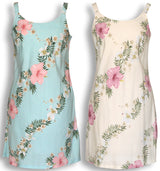

Ask about Paradise Lei Bias Cut Dress
Paradise Lei Bias Cut Dress — the one that hangs right on a pear shape
If your hips measure more than your bust and most dresses either strain across the seat or hang like a sack from the shoulder, this is the cut to try. The fabric is cut on the bias, so it follows the body instead of fighting it: it skims the hip rather than gripping it, and the darted bust and waist give shape up top where straight-cut dresses go flat. Customers who buy it usually come back for a second one because it's the rare dress that photographs well and still lets you sit down through dinner.
- Fit — bias cut, figure-hugging and slimming, shaped for a pear figure
- Length — knee length
- Shaping — darted bust, darted waist, darted back
- Closure — back zipper
- Fabric — 100% rayon, made in Hawaii
How This Fits
Bias-cut rayon behaves differently from a woven straight cut — it stretches diagonally and settles onto the frame after a few minutes of wear, so it reads closer to the body than the same size in a shift dress would. The darts do the work at the bust and waist; the drape does the work over the hip. If you want a tighter line through the middle, a sweater clip, shawl clip or cardigan clip at the back gathers the fabric in for a more fitted look without altering the dress. Knee length sits at or just below the knee on most heights. Because sizing on this style depends heavily on where you carry width, call or email us before you order and we'll go through your bust, waist and hip numbers with you.
Wear It For
Anniversary dinners, an evening out where the restaurant has a dress code, mainland weddings as a guest, church, cruise formal nights, and office days when you want something that isn't a suit. Add a shawl or cardigan and it carries straight through into cooler weather.
Care
Rayon on the bias needs a gentle hand: cold wash or dry clean, hang to dry rather than tumbling, and press with a warm iron. Never put it in a hot dryer — heat is what shrinks rayon and a bias cut will pull crooked if it does.
Why Shop MauiShirts?
- Selling Hawaiian clothing from our Maui showroom since 1998 — 28 years
- We talk fit honestly, including which body shapes a cut suits and which it doesn't
- Real people on the phone and on email before you order, not after
- Free shipping to anywhere in the USA and its territories — no minimum order. Priority Mail and FedEx available if you need it faster.
Common Questions
Why is a bias cut better for a pear shape? The diagonal grain lets the fabric release over the hip and seat instead of pulling tight there, while the bust and waist darts keep definition above the widest point.
Can I make it more fitted? Yes — a sweater, shawl or cardigan clip at the back takes up the slack through the waist and gives a closer line.
How long is it exactly? Knee length. On taller frames it will sit right at the knee; on shorter frames, just below.
What do I wear over it when it cools off? A cardigan or a shawl works with the neckline and doesn't fight the drape. Anything heavy and structured will flatten the bias line.
MauiShirts.com · Care Guide
How Do I Care for My Made-in-Hawaii Clothes?
Cold water, mild soap, and a line to dry on. That's most of it — but rayon and cotton want slightly different handling, and one common mistake will ruin a white shirt permanently.
The short answer Wash in cold water with a mild soap — by hand, or on your machine's gentle cycle. Never use hot water and never use bleach. Line dry in the shade. Iron cool, or use steam. Hot water is what shrinks these garments and dulls the print, and it does it the first time, not the tenth.
Cotton or rayon? Start here
Nearly everything we sell is 100% cotton or 100% rayon. Check the product page or your garment's label. The care is similar, but rayon is far less forgiving when wet, so it's worth knowing which one you're holding.
100% Cotton
The forgiving one
- Wash
- Machine, gentle cycle, cold water
- Dry
- Line dry, or tumble on cool and remove while slightly damp
- Iron
- Cool to warm, inside out
- Watch for
- Shrinkage if the water is warm. Cotton relaxes and softens with wear.
100% Rayon
The delicate one
- Wash
- Dry clean for best results, or hand wash cold
- Dry
- Line dry only, in shade, on a padded hanger
- Iron
- Cool or steam, inside out, while slightly damp
- Watch for
- Rayon loses much of its strength when wet. Don't wring, twist, or hang it heavy.
Hot water is the one thing to avoid. Both rayon and cotton shrink in hot water, and rayon also loses its luster — that soft sheen is what you paid for. Cold water, every time.
Washing, step by step
- Turn the garment inside out. This protects the printed surface and keeps coconut and shell buttons from knocking against the drum.
- Wash separately the first time, or with like colors. Deep reds and navies on Hawaiian prints can release dye in the first wash or two.
- Use cold water and a mild soap. Plain Ivory works well. Skip the heavy detergents and anything labeled "brightening."
- Don't let it soak. A long soak sets dye bleed rather than preventing it, and it's especially hard on rayon.
- Machine users: gentle cycle only, cold, with a short spin. Hand washers: swish, don't scrub, and press the water out rather than wringing.
- Reshape it while damp and get it onto the line or a hanger before wrinkles set.
Never use Woolite on a white shirt with a red print. It will lift the red dye into the white ground and there is no undoing it. This is the single most common way we see a good shirt ruined. Skip bleach entirely as well, on every color.
Drying
Line drying is best, and it isn't close. Hang the garment in the shade — direct Hawaiian sun will fade a print faster than any wash cycle. Use a padded or wide hanger for rayon so the shoulders don't develop points.
If you must use a dryer, run it on the coolest setting and take the garment out while it's still slightly damp. Heat is what sets wrinkles and shrinks the weave. For rayon, skip the dryer altogether.
Ironing
Use a cool iron or steam only. Press on the inside, or lay a thin cloth between the iron and the fabric so the print never touches hot metal. Rayon irons best when it's still a little damp. If a garment has come out badly creased, a steamer will do the job with no risk at all.
Buttons, prints and handmade details
Many of our shirts and dresses are made in small runs in Hawaii by Two Palms, Pacific Legend, Paradise Found, RJC and others. Coconut, shell and wood buttons are common, and they're not machine parts — they'll chip if they get knocked around on a heavy cycle. Turning the garment inside out and using the gentle cycle takes care of it.
Silk-screened prints are laid onto the fabric, not woven in. Wash them inside out and keep them out of direct sun on the line, and they'll stay sharp for years.
The bitterness of poor quality remains long after a cheaper price is forgotten. It's not that the shirt or dress looks good — it's how long they look good.Something we read years ago, and still believe
Storing your aloha wear
- Hang, don't fold, if you have the closet room — especially rayon, which holds a crease.
- Make sure it's fully dry before it goes away. Hawaii's humidity and a damp collar will find each other.
- Keep it out of the light. A closet is better than a hook by the window.
- No plastic dry-cleaning bags for long-term storage. Fabric needs to breathe.
Repairs
If a seam gives way, don't throw the garment out. Send it back to us and we'll re-sew it — you cover the shipping both ways. We'd rather fix a shirt than see it retired early.
One note before you wash something new. If a garment doesn't fit or isn't what you expected, send it back before washing it. Once an item has been machine washed we can't accept it as a return or exchange. See our Shipping & Returns page for the 30-day window.
Quick reference
| Step | 100% Cotton | 100% Rayon |
|---|---|---|
| Water | Cold | Cold |
| Method | Machine, gentle cycle | Dry clean, or hand wash |
| Soap | Mild — Ivory is ideal | Mild — Ivory is ideal |
| Bleach | Never | Never |
| Soaking | No | No |
| Drying | Line dry, or cool tumble | Line dry in shade only |
| Ironing | Cool to warm, inside out | Cool or steam, slightly damp |
| Wringing | Avoid | Never — press water out |
Common Questions
Will my aloha shirt shrink?
Not if you wash it in cold water and keep it out of a hot dryer. Both cotton and rayon shrink when they meet heat, and most of that happens on the very first wash. Cold water and a line is all the insurance you need.
Can I machine wash 100% rayon?
We recommend dry cleaning or hand washing. Rayon fibers lose much of their strength when wet, so a machine's agitation and spin put real stress on the seams. If you do machine wash it, use the gentle cycle, cold water, and a mesh bag — and never put it in the dryer.
Why can't I use Woolite on a white shirt with red in the print?
It lifts the red dye and carries it into the white background, leaving a pink haze that can't be washed out. Use a plain mild soap instead. This applies to any white-ground garment with a strong red or dark print.
Is dry cleaning worth it?
For rayon, often yes — it gives the best result and takes all the risk out. For cotton, cold water at home does the job well.
My shirt came out wrinkled. What now?
Steam is your friend. Hang it in the bathroom during a hot shower, or run a steamer over it. If you iron, keep the setting cool and press on the inside of the garment so the iron never touches the print.
How do I get a stain out without bleach?
Work on it cold and early. Blot — don't rub — with cool water and a little mild soap, working from the outside of the stain inward. Heat sets a stain permanently, so don't dry the garment until the mark is gone. For anything stubborn on rayon, take it to a dry cleaner and point out the spot.
Can I return something after I've washed it?
No. Once an item has been machine washed it can't be returned or exchanged. If you're unsure about fit, try it on and send it back unwashed within 30 days.
Still not sure?
Tell us which garment you have and we'll tell you exactly how to handle it. We've been selling made-in-Hawaii aloha wear since 1998.
Email jz@MauiShirts.comLast updated August 2026